
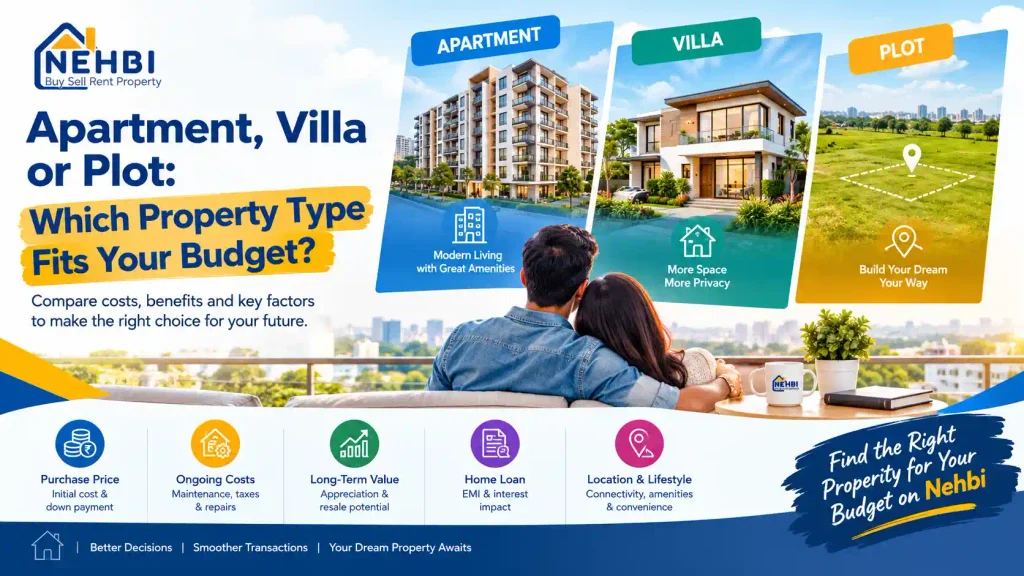
Buying a property is a major financial decision. Whether you are purchasing your first home, planning to move your family into a bigger space, or investing for the future, choosing the right property type is just as important as choosing the right location.
In India, buyers commonly consider three options: apartments, villas and residential plots. Each offers different benefits, costs and responsibilities. Apartments may be more affordable and easier to maintain, villas offer greater privacy and space, while plots provide flexibility to build a home according to your preferences.
But which option is right for your budget?
In this guide, we will compare apartments, villas and plots to help you understand their costs, advantages, limitations and suitability for your financial goals.
1. Apartment, Villa or Plot: Understanding the Differences
Before comparing prices, understand what each property type offers.
Apartment
An apartment is a residential unit within a larger building or housing complex. Buyers typically share common facilities such as lifts, parking areas, security systems, gardens and other amenities.
Apartments are popular among working professionals, small families and first-time homebuyers because they often offer a convenient location and shared maintenance arrangements.
Villa
A villa is an independent or semi-independent home that generally offers more private space than an apartment. Depending on the project, it may include a private garden, terrace, parking area and multiple floors.
Villas usually cost more than apartments in the same locality, although prices depend on the location, land area, construction quality and amenities.
Residential plot
A residential plot is a piece of land intended for residential development, subject to applicable planning rules and approvals.
Buying a plot allows you to plan and construct a house according to your budget and requirements. However, construction costs are separate from the land purchase price, and building may require approvals, utilities and additional time.
2. Apartment vs Villa vs Plot: Cost Comparison
The purchase price is only one part of the total cost. You should also consider registration, taxes, maintenance, construction and future expenses.
| Cost factor | Apartment | Villa | Residential plot |
|---|---|---|---|
| Initial purchase cost | Often moderate | Often higher | Depends on location and plot size |
| Construction cost | Usually included in the property price | Usually included for a completed villa | Additional if you plan to build |
| Maintenance | Shared society charges and interior repairs | Owner-managed or community charges | Land upkeep and security |
| Privacy | Moderate | Generally higher | Depends on the home you eventually build |
| Time before moving in | Usually immediate for a ready home | Usually immediate for a ready villa | Construction may take considerable time |
| Flexibility to design | Limited by building rules | Depends on the property and rules | Greater design flexibility, subject to approvals |
| Rental potential | Depends on location and demand | Depends on location and tenant demand | Vacant land generally has different rental prospects |
Important: These are general comparisons, not fixed rules. A premium apartment in a major city may cost more than a villa or plot in a smaller city. Always compare properties in the same location and at a similar level of quality.
3. Is an Apartment the Best Choice for Your Budget?
Apartments can be a practical option for buyers who want a ready-to-use home without managing an entire building independently.
Benefits of buying an apartment
1. More options across budgets
Apartments are available in different sizes, configurations and locations. This gives buyers the flexibility to compare smaller units, larger family homes and premium residences.
2. Shared amenities
Many apartment projects provide security, lifts, parking, gardens, gyms or community spaces. The availability and quality of these facilities vary by project.
3. Convenient locations
Apartments are often available near offices, schools, hospitals, shopping areas and public transport, particularly in urban neighbourhoods.
4. Easier maintenance management
Common areas are generally managed through a housing society, association or appointed facility manager, although owners still pay applicable maintenance charges and handle repairs within their units.
What should you consider?
Apartment buyers should check monthly maintenance fees, parking arrangements, water supply, construction quality, society rules and the building’s long-term upkeep.
Before purchasing, verify the property’s title, applicable approvals and RERA registration where required. Review the agreement carefully and confirm whether the quoted price includes parking, amenities and other charges.
Best suited for: First-time homebuyers, working professionals, small families and people who prefer convenience with relatively predictable maintenance arrangements.
4. Is a Villa Worth the Extra Investment?
A villa can be attractive for buyers who want more space, privacy and independence. However, the higher purchase price may not suit every budget.
Benefits of buying a villa
1. More personal space
Villas often provide multiple bedrooms, private outdoor areas, terraces or additional rooms for working from home.
2. Greater privacy
Compared with many apartment layouts, villas generally offer more separation from neighbours and fewer shared walls.
3. More control over the property
Owners may have greater freedom to modify interiors, landscaping and certain exterior features, subject to local laws, project covenants and community rules.
4. Potential long-term appeal
A villa in a well-connected location may appeal to families seeking a larger home. However, resale demand and appreciation depend on local market conditions.
What should you consider?
Villas can involve higher upfront costs, property taxes, insurance, repairs and ongoing maintenance. Owners may need to manage gardens, plumbing, roofing, security and other services independently.
If the villa is part of a gated community, check whether there are additional association charges and restrictions.
Best suited for: Families needing more space, buyers with a higher housing budget and people planning to stay in the same location for many years.
5. Is Buying a Plot a Smart Property Investment?
A residential plot can be appealing if you want to build a home in the future or prefer to decide the design and construction timeline yourself.
However, land ownership requires careful due diligence.
Benefits of buying a plot
1. Build according to your needs
You can plan the number of rooms, layout, floors and features based on your family’s requirements, subject to building regulations and approvals.
2. Construction can be planned in stages
Depending on your finances and local regulations, you may be able to purchase the land first and construct later. Remember that construction costs can increase over time.
3. No apartment-style common maintenance
A vacant plot does not have the same building maintenance requirements as an apartment. However, fencing, cleaning, security, land taxes and other upkeep may still be necessary.
4. Potential for land value appreciation
Plots in areas with improving connectivity and infrastructure may appreciate, but this is not guaranteed. Some plots can remain difficult to sell, especially when access, approvals or local demand are weak.
What should you consider?
Before buying a plot, verify ownership records, title history, land-use classification, permitted development, road access, boundaries and any encumbrances or disputes.
Check whether the layout and development have the necessary approvals. Do not assume that a plotted project is legally approved simply because it is advertised as a residential development.
Also calculate the future cost of construction, utility connections, boundary walls, professional fees and approvals.
Best suited for: Buyers who do not need to move immediately, want to design their own home or have a long-term land ownership plan.
6. How to Choose According to Your Budget
The right property depends on how much you can comfortably spend without putting pressure on your savings.
If your budget is limited
Consider a smaller apartment or a property in a developing but well-connected neighbourhood. Compare the total purchase cost, commute, maintenance charges and resale prospects rather than focusing only on the lowest advertised price.
A plot may have a lower purchase price in some locations, but you must include construction costs before comparing it with a completed home.
If you have a moderate budget
Compare apartments with smaller villas or plots in suitable locations. An apartment may provide better access to daily conveniences, while a plot may give you more flexibility if you can wait before building.
If you have a higher budget
A villa may offer the space and privacy you want, while a larger apartment may provide more amenities or a more central location. Compare the lifestyle benefits against the total cost of ownership.
If you are buying for investment
Do not choose a property type based on assumptions alone. Study local rental demand, vacancy rates, resale activity, infrastructure development, holding costs and the ease of selling the property.
A plot may not generate regular rental income while vacant, whereas apartments and villas may generate rent if there is sufficient tenant demand. Rental income and capital appreciation are both uncertain.
7. Example: How to Compare Your Total Budget
Imagine you have a total property budget of ₹60 lakh.
You are considering:
- An apartment priced at ₹55 lakh.
- A villa priced at ₹75 lakh.
- A residential plot priced at ₹30 lakh.
At first glance, the plot appears to be the most affordable. But the comparison changes when you include additional expenses.
For the apartment, you may need to budget for registration, applicable taxes, moving expenses, furnishing and maintenance.
For the villa, you would need to determine whether the higher purchase price fits your borrowing capacity and whether sufficient savings remain for repairs and other costs.
For the plot, you would need to add the cost of construction, approvals, utilities, boundary work and any other development expenses. A ₹30 lakh plot with a ₹35 lakh construction budget would already exceed ₹60 lakh before additional charges.
This example shows why the lowest purchase price is not always the lowest total cost.
Before deciding, calculate the full cost of owning or completing the property and keep an emergency fund separate from your housing budget.
8. Home Loan and Financing Considerations
Financing can influence which property type is affordable.
For a completed apartment or villa, buyers may be able to use a home loan, subject to lender eligibility and property verification.
Plots may qualify for land or plot loans, while construction loans may be available separately or under specific combined arrangements. Eligibility, permitted land use, loan-to-value ratios, interest rates and repayment terms vary by lender.
Before applying for a loan:
- Compare interest rates and processing fees.
- Check the down payment required.
- Calculate the EMI you can comfortably afford.
- Include registration, taxes and other upfront costs.
- Avoid using all your savings for the purchase.
- Review the loan terms and conditions carefully.
Do not base your budget only on the maximum loan amount a lender offers. Consider your monthly expenses, existing debts, family needs and future financial commitments.
9. Important Checks Before Buying Any Property in India
Whichever option you choose, complete your legal and practical checks before paying a large amount.
- Verify the title: Confirm that the seller has the legal right to transfer the property.
- Check approvals: Review applicable building permissions, land-use approvals and occupancy or completion documents where relevant.
- Review RERA details: Check project registration where required and verify the information with the relevant state RERA authority.
- Understand all charges: Ask for a written breakdown of the price, taxes, registration costs, maintenance deposits and other fees.
- Inspect the property or land: Check construction quality, access roads, drainage, water supply and electricity arrangements.
- Review the agreement: Understand payment schedules, possession dates, penalties and other contractual terms.
- Seek professional advice: A property lawyer can help identify legal risks before you commit.
These checks are especially important when purchasing plots, where unclear ownership or land-use restrictions can create significant problems.
10. Find a Property That Fits Your Budget with Nehbi
Choosing between an apartment, villa and plot becomes easier when you understand your budget, preferred location and long-term plans.
Before making a decision, compare different properties based on total cost, accessibility, available facilities, legal status and future requirements.
Visit Nehbi to explore property options and begin your search for a home or land that matches your needs.
Take your time, compare alternatives and make a decision based on both your current finances and your future plans.
Frequently Asked Questions (FAQs)
1. Which is cheaper: an apartment, villa or plot?
It depends on the city, locality, size and property condition. Apartments can offer lower entry costs than villas in the same area. Plots may cost less initially, but construction and development expenses must be included in the final budget.
2. Is buying a plot better than buying an apartment?
A plot may be suitable if you want to build a customised home or hold land for the future. An apartment may be more suitable if you need a ready home, shared amenities and easier access to urban facilities. Neither guarantees better investment returns.
3. Which property type is best for a middle-class family in India?
An apartment may be a practical starting point for many families because it offers different sizes and price ranges. However, the best choice depends on household income, location, commuting needs, family size and available savings.
4. Is a villa a good investment in India?
A villa may suit buyers who want space and privacy, and it may appreciate in value if local demand supports it. However, the higher purchase price and maintenance costs should be considered. Appreciation and resale performance are not guaranteed.
5. What is the difference between buying a plot and buying a constructed house?
Buying a plot means purchasing land, with construction costs and approvals generally handled separately. Buying a constructed house means purchasing a property that already has a building, subject to its legal status and condition.
6. What should I check before buying a residential plot?
Verify the title, ownership history, land-use classification, permitted construction, boundaries, access roads, applicable layout approvals and any encumbrances or disputes. Consult a qualified property lawyer before completing the transaction.
7. Should I buy a property with a home loan?
A home loan may help you purchase a property without paying the entire amount upfront. However, you should consider the EMI, interest cost, down payment, other charges and the stability of your income before borrowing.
Conclusion
Apartments, villas and residential plots each have their own advantages. Apartments can offer convenience and a range of budget options, villas provide more privacy and space, and plots give you flexibility to build according to your plans.
The best choice is not necessarily the most expensive property or the one with the lowest initial price. It is the property that fits your complete budget, meets your needs and supports your long-term financial goals.
Compare your options carefully, verify all legal documents and calculate the total cost before making a commitment.
Explore your property options on Nehbi and take the next step towards finding the right property for your budget.