
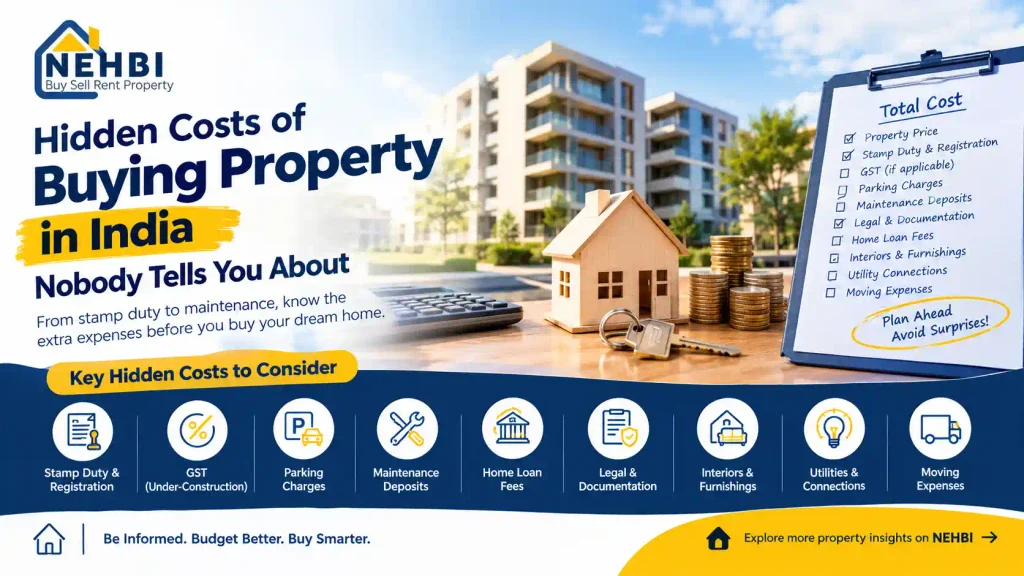
Buying a home is a major financial milestone. Many buyers spend months comparing locations, checking property prices, and choosing the right apartment or house. However, one important detail is often overlooked: the actual cost of buying a property is usually higher than its advertised price.
From stamp duty and registration charges to GST, parking fees, maintenance deposits, and interior work, several additional expenses can increase your budget significantly.
Understanding the hidden costs of buying property in India can help you avoid financial surprises, plan your home loan properly, and make a more confident decision.
In this guide, we explain the additional expenses you should consider before finalising your property purchase.
1. Stamp Duty and Property Registration Charges
Stamp duty and registration charges are among the biggest additional expenses when purchasing property in India.
Stamp duty is a state-level charge associated with property transactions, while registration charges cover the official registration of the sale deed. The applicable rates depend on the state, property value, property type, and other factors.
For example, if you purchase a property worth ₹50 lakh, even a few percentage points in stamp duty can add a substantial amount to your expenses.
What you should do: Check the current rates with your state’s registration department before finalising your budget. Do not assume these charges are included in the advertised property price.
2. GST on Under-Construction Properties
Goods and Services Tax (GST) may apply when purchasing an eligible under-construction residential property from a developer.
The applicable treatment depends on the property category and the relevant tax rules. Under the commonly applicable concessional rates, eligible residential apartments may attract GST at 1% for affordable housing and 5% for other residential housing, subject to the applicable conditions.
Generally, GST is not charged on the sale of a completed property where the relevant completion-certificate or first-occupation conditions are met.
Before booking, ask the builder for a written breakdown of the property price, applicable GST, and other charges. Verify the tax treatment for your specific transaction with a qualified tax professional.
3. Parking Charges
Parking is another expense buyers may not account for when comparing property prices.
Depending on the project and agreement, a developer may quote separate charges for parking-related facilities or other permitted parking arrangements.
Before making a payment, ask:
- Is parking included in the quoted property price?
- What type of parking facility is provided?
- Is the parking arrangement clearly documented?
- Are the charges permitted under applicable rules?
- What does the sale agreement say about parking rights?
Do not rely only on verbal promises. Review the agreement and relevant local regulations before paying additional charges.
4. Maintenance Deposits and Society Charges
Many residential projects require buyers to pay maintenance-related amounts before possession.
These expenses may include an advance maintenance payment, a corpus or sinking fund contribution, common-area maintenance, or other charges specified in the agreement.
The amount varies by property, building, facilities, and society arrangements.
For example, a residential complex with lifts, security, landscaped gardens, a gym, and other shared amenities may have higher recurring maintenance expenses than a smaller building.
Tip: Ask for a written list of one-time deposits and recurring monthly or annual charges. Include them in your budget before booking.
5. Home Loan Processing and Other Banking Fees
If you are financing your property through a home loan, remember that the interest rate is not the only borrowing expense.
Depending on the lender and loan product, you may encounter:
- Loan processing fees
- Legal verification charges
- Property valuation fees
- Documentation or administrative charges
- Mortgage-related stamp duty or registration costs, where applicable
- Charges associated with required insurance products, if any
Ask the lender for a complete list of charges before accepting the loan offer. Compare the total borrowing cost, not just the advertised interest rate.
6. Legal Verification and Documentation Costs
Property documents should be checked carefully before you make a major financial commitment.
You may choose to hire a property lawyer to review the title documents, sale agreement, approvals, and other relevant records.
Depending on the transaction, verification may cover:
- Ownership and title history
- Encumbrances and existing loans
- Approved building plans
- Required permissions and certificates
- Sale agreement conditions
- Outstanding property tax or utility dues
- Relevant RERA project information
Professional legal advice adds to your upfront expenses, but it can help you identify problems before completing the purchase.
7. Interior Design and Renovation Expenses
A property may look attractive during a visit, but it may not be ready for comfortable living.
You could need to spend money on wardrobes, kitchen cabinets, lights, fans, curtains, appliances, painting, furniture, or other interior work.
Ready-to-move homes may also need repairs or upgrades, particularly if the property has been occupied previously.
Before purchasing, prepare a realistic list of essential work and obtain quotations from contractors. Keep a contingency amount for unexpected repairs rather than spending your entire budget on the purchase itself.
8. Electricity, Water, Gas and Utility Connections
New homeowners may have to pay charges related to electricity connections, water supply, gas connections, meters, or other utility arrangements.
Some charges may already be included in the agreement, while others may be payable separately. Requirements vary by project and local authority.
Ask the developer or seller to confirm which connections are available, which are operational, and which expenses remain outstanding.
Also check whether there are unpaid utility bills associated with the property before completing the transaction.
9. Property Insurance and Home Protection
Property insurance is another expense worth considering.
A home insurance policy may provide protection against specified risks, depending on its terms and exclusions. You may also consider insurance for household contents.
If you have a home loan, check whether the lender requires any particular insurance arrangement. Review the coverage, premium, exclusions, and policy conditions before purchasing.
Do not assume that a home loan automatically includes comprehensive property insurance.
10. Brokerage and Property Search Expenses
If you use a real estate agent, brokerage may increase your overall buying cost.
The amount and payment terms depend on the agreement with the agent and local market practices.
You may also spend money travelling to property sites, arranging inspections, obtaining professional advice, or visiting different neighbourhoods.
Before engaging an agent, confirm the brokerage amount, when it becomes payable, and what services are included. Keep the terms in writing.
11. Property Tax and Outstanding Dues
Property tax is generally a recurring ownership expense, but outstanding dues may also need attention when buying an existing property.
Before completing the purchase, confirm the status of property tax, water bills, electricity bills, and society maintenance payments.
Clarify in the sale agreement who is responsible for dues arising before and after the transaction.
This is particularly important when purchasing a resale apartment or an independent house.
12. Moving Expenses and Initial Living Costs
Once the property is registered and possession is available, you may still have expenses before settling in.
These may include:
- Packers and movers
- Furniture transportation
- Appliance installation
- Internet setup
- Curtains, lights, and essential household items
- Minor repairs and cleaning
- Temporary accommodation, if required
These expenses may seem small compared with the property price, but together they can affect your available savings.
Example: How Hidden Costs Can Increase Your Property Budget
Consider a hypothetical residential property advertised at ₹50 lakh. The figures below are illustrative only and are not official rates or a quotation for a specific city.
| Expense | Illustrative amount |
|---|---|
| Advertised property price | ₹50,00,000 |
| Stamp duty and registration provision | ₹3,00,000 |
| Legal and documentation expenses | ₹25,000 |
| Loan processing and valuation provision | ₹15,000 |
| Maintenance deposit and other permitted charges | ₹60,000 |
| Basic interiors and appliances | ₹1,50,000 |
| Moving and setup expenses | ₹25,000 |
| Estimated total before any applicable GST | ₹55,75,000 |
In this example, the additional expenses add ₹5.75 lakh to the advertised price. Actual costs may be lower or higher depending on the location, property type, applicable taxes, loan terms, and what is already included in the agreement.
For an under-construction property, assess whether GST applies and include the relevant amount in your calculation. Avoid adding GST automatically to a completed property when the applicable conditions make the sale exempt from GST.
Checklist: Expenses to Calculate Before Buying a Property
Use this checklist before paying a booking amount or signing the final agreement.
- Property price and payment schedule
- Stamp duty and registration charges
- GST, if applicable
- Parking and other permitted additional charges
- Maintenance deposit and recurring society charges
- Home loan processing and valuation fees
- Legal verification and documentation
- Utility connections and outstanding bills
- Interior work, furniture, and appliances
- Property insurance, if required or desired
- Brokerage, if applicable
- Moving expenses and emergency funds
Request a written cost sheet from the developer or seller and compare it with your own estimate.
How to Avoid Hidden Costs When Buying Property in India
You can reduce unexpected expenses by following a few simple steps.
1. Set a total budget: Decide how much you can afford to spend overall, rather than focusing only on the property’s base price.
2. Ask for an itemised cost sheet: Request a clear breakdown of taxes, deposits, parking, amenities, and other charges.
3. Compare properties fairly: Compare the total cost of similar properties, including possession-related and recurring expenses.
4. Verify documents independently: Check the title, approvals, applicable RERA registration, and agreement conditions. Consider professional legal advice.
5. Understand your home loan: Review the processing fees, interest, repayment schedule, and other borrowing costs.
6. Keep an emergency reserve: Avoid using every available rupee for the down payment and purchase expenses.
7. Read the agreement carefully: Confirm what is included in the price, which charges are additional, and how payment obligations are defined.
For more property-related information and local services, visit Yonoj.
Conclusion
Buying a property in India involves more than paying the advertised price. Stamp duty, registration, applicable GST, maintenance deposits, legal fees, loan charges, interiors, and moving expenses can increase the amount you need.
The best way to avoid financial surprises is to calculate the full cost before booking the property. Ask questions, verify the documents, and get all important charges confirmed in writing.
A well-planned purchase can help you protect your savings, manage your home loan comfortably, and enjoy your new home with greater confidence.
Frequently Asked Questions
1. What are the hidden costs of buying property in India?
Common additional expenses include stamp duty, registration charges, applicable GST, parking-related charges, maintenance deposits, legal fees, loan processing costs, interiors, utilities, and moving expenses.
2. How much extra money should I keep aside when buying a house?
There is no single amount that applies to every purchase. The additional budget depends on the state, property value, property type, applicable taxes, loan terms, and finishing requirements. Calculate each cost separately and keep an emergency reserve.
3. Is GST applicable to every property purchase?
No. GST treatment depends on the transaction. It may apply to eligible under-construction residential purchases, while sales of completed properties meeting the relevant completion-certificate or first-occupation conditions are generally outside GST.
4. Are stamp duty and registration charges included in the property price?
They are often payable separately unless the agreement explicitly provides otherwise. Confirm the applicable charges with the relevant state registration authority.
5. Can a builder charge separately for parking?
Parking arrangements and charges depend on applicable law, project documentation, and the nature of the facility. Check the sale agreement and relevant local rules before paying.
6. What should I check before buying a resale property?
Verify ownership and title, relevant approvals, outstanding property tax and utility bills, society dues, existing loans or encumbrances, and the condition of the property.
7. Are home loan processing fees included in the interest rate?
Usually, the interest rate and processing fees are separate components of the loan cost. Ask your lender for a complete fee schedule and review the loan documents.
8. How can I reduce the total cost of buying a property?
Compare the full cost of multiple properties, negotiate where possible, check all charges in writing, verify documents before committing, compare home loan offers, and avoid unnecessary interior expenses.