blog

Nehbi - Buy, Sell & Rent Verified Properties Across India

Office Space vs Retail Shop: Which Commercial Property Should You Buy?
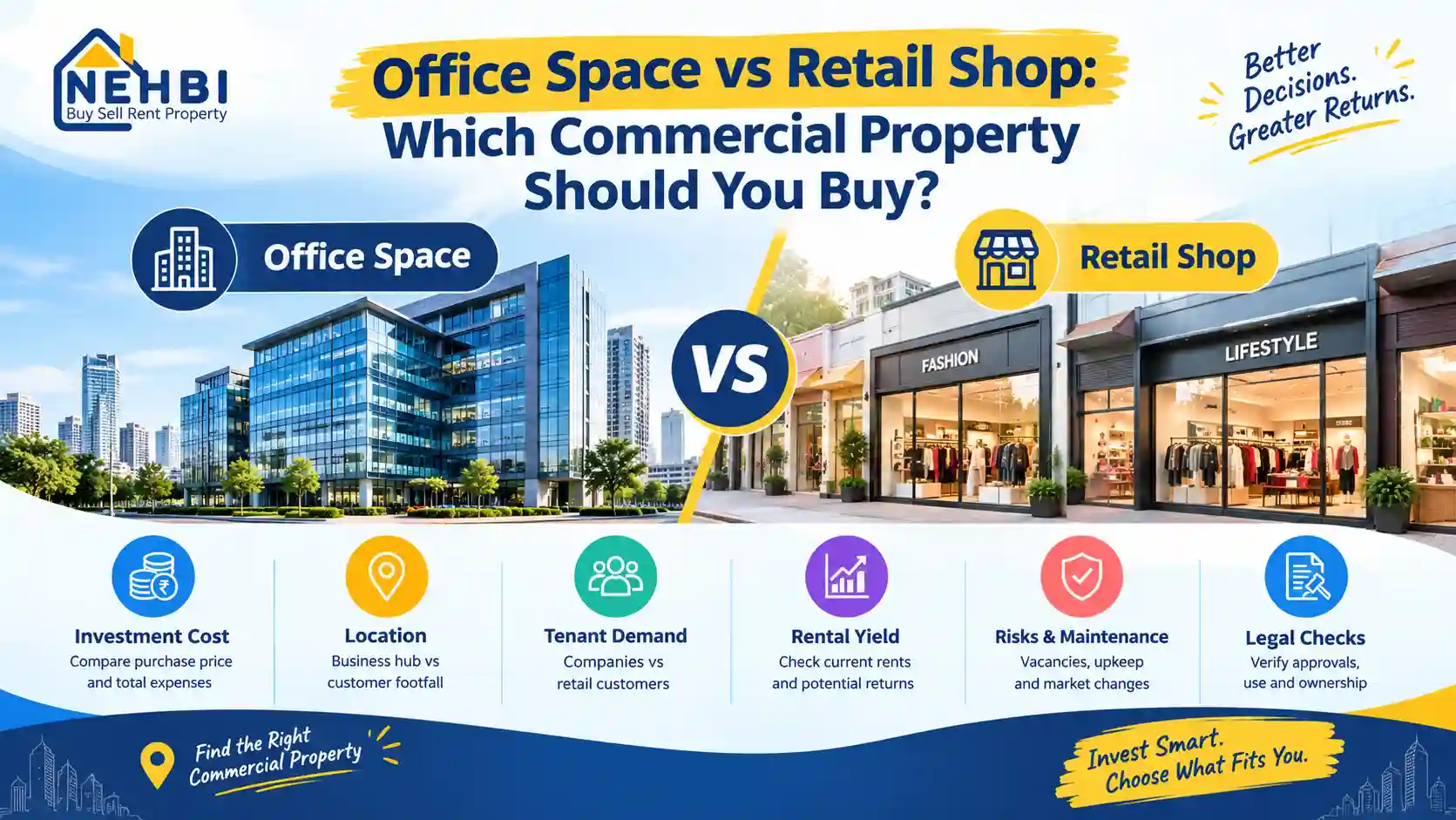
Office Space vs Retail Shop: Which Commercial Property Should You Buy?

Investing in commercial property can be an effective way to diversify your investments and potentially earn rental income. However, choosing the right property is important because different commercial spaces attract different tenants, involve different costs, and perform differently depending on location and market demand. Two popular options for commercial property investors in India are office spaces and retail shops. Office spaces are generally used by businesses, professionals, and companies, while retail shops are designed for businesses that sell products or provide services directly to customers. But which option is better for your investment goals? The answer depends on your budget, preferred location, expected rental income, tenant demand, maintenance costs, and willingness to manage the property. In this guide, we compare office space vs retail shop investments to help you make a more informed decision. 1. Understanding Office Space Investment Office spaces are commercial properties used for business operations. They can include small private offices, coworking units, corporate offices, and larger commercial floors. Typical tenants include IT companies, consultants, financial service providers, startups, agencies, and professional firms. Advantages of buying office space Disadvantages of office space Before buying, check whether the office is suitable for the businesses operating in that area. Connectivity, internet infrastructure, parking, lifts, power backup, and building management can all influence tenant interest. 2. Understanding Retail Shop Investment Retail shops are commercial units used to sell products or provide services directly to customers. Examples include grocery stores, pharmacies, salons, clothing shops, mobile stores, cafés, and other local businesses. Their performance often depends on visibility, customer movement, neighbourhood demand, accessibility, and the surrounding business environment. Advantages of buying a retail shop Disadvantages of retail shops A retail shop’s value depends on more than its size. Check road access, frontage, signage opportunities, parking, nearby businesses, and whether the surrounding area attracts the right customers. 3. Office Space vs Retail Shop: Key Differences Factor Office Space Retail Shop Main tenants Companies, professionals, service businesses Retailers, salons, pharmacies, cafés, service providers Important location factors Business hubs, transport, office infrastructure Visibility, customer access, footfall Rental demand Depends on business activity and office requirements Depends on local spending, customer movement, and business demand Tenant arrangement May suit longer leases for established businesses Lease duration varies by business and location Property features Layout, lifts, parking, internet, power backup Frontage, visibility, access, signage Maintenance May include building management and common-area costs May include building costs and shop-specific upkeep Main risk Office vacancies and changing business demand Low footfall and weak retail demand Best suited for Investors targeting business tenants Investors targeting customer-facing businesses Neither option is automatically better. A well-located office may outperform a poorly positioned shop, while a shop in a strong local market may be more attractive than an office in an area with weak tenant demand. 4. Compare Your Investment Budget Your budget should include more than the property’s advertised price. Commercial property purchases may involve stamp duty, registration fees, applicable taxes, legal checks, brokerage, fit-out costs, and ongoing maintenance charges. Before deciding, calculate the complete acquisition cost. For example, an office in a business district may have a higher purchase price but appeal to established businesses. A smaller retail shop may cost less initially, but its rental potential will depend on visibility and customer demand. Compare properties using the same financial measures: Avoid choosing a property simply because its initial price appears affordable. A cheaper property with weak tenant demand may produce a lower return or require more time to rent out. 5. Calculate the Potential Rental Yield Rental yield helps investors compare the rent generated by different properties against their purchase cost. The basic gross rental yield formula is: Gross rental yield = (Annual rent ÷ Total purchase price) × 100 For example, suppose an office space costs ₹50 lakh and earns ₹30,000 per month in rent. Now suppose a retail shop costs ₹40 lakh and earns ₹25,000 per month. In this illustrative example, the shop has a higher gross rental yield. However, these figures do not represent actual market rates or guaranteed returns. Gross yield also excludes vacancy, maintenance, taxes, financing costs, and other expenses. Calculate the net return after relevant costs before comparing investments. 6. Choose the Right Location Location is one of the most important factors in commercial property investment, but the ideal location differs between office spaces and retail shops. For office spaces Look for areas with: For retail shops Look for areas with: Visit the location at different times and on different days. Observe customer movement, traffic, neighbouring businesses, vacant units, and nearby construction. A busy road alone does not guarantee that a particular shop will attract customers. 7. Understand the Risks Before Buying Commercial properties can offer rental opportunities, but they also involve financial and legal risks. Before buying either property type, consider the following. Vacancy risk: If a tenant leaves, you may need to cover expenses until another tenant is found. Tenant concentration: Relying on one tenant means rental income can stop if that tenant leaves or fails to pay. Market risk: Local business conditions, new developments, and changes in demand can affect rents and resale values. Maintenance risk: Building repairs, common-area expenses, equipment replacement, and refurbishment can reduce your returns. Liquidity risk: Commercial properties may take time to sell, particularly if they are in specialised buildings or locations with limited demand. Legal and approval risk: Title issues, building approvals, permitted use, and restrictions can affect your ability to rent or resell the property. Maintain a financial buffer for unexpected costs, and avoid assuming that a property will remain occupied continuously. 8. Check Legal Documents Before Purchasing Legal verification is essential for both office spaces and retail shops. Before paying a substantial advance or signing a binding agreement, consider having a qualified property lawyer review the relevant documents. Important checks include: For under-construction projects, verify the project’s applicable registration and disclosures on the relevant state RERA portal, where required. Requirements can vary depending on the project and transaction. Do not rely solely on … Read more

Buying Commercial Property in India: A Beginner’s Guide for Small Investors

Investing in commercial property can be an interesting way to build long-term wealth and earn rental income. Unlike residential properties, commercial properties are used for business activities, including offices, retail shops, showrooms, warehouses, and other commercial purposes. For small investors in India, buying commercial property may seem complicated because of the higher investment amount, legal requirements, property management responsibilities, and changing market conditions. However, with proper research and financial planning, beginners can make more informed investment decisions. Before investing your savings, it is important to understand the different types of commercial properties, how rental income works, what documents to verify, and which risks to consider. This guide explains how to buy commercial property in India as a beginner and what small investors should check before making a purchase. What Is Commercial Property? Commercial property refers to real estate primarily used for business or income-generating activities. It can be purchased to earn rental income, operate a business, or potentially benefit from long-term appreciation. Common types of commercial properties include: Each property type has different costs, tenant requirements, vacancy risks, and potential returns. Your choice should depend on your budget, preferred investment period, and understanding of the local market. Why Should Small Investors Consider Commercial Property? Commercial property can offer several potential benefits, although returns are never guaranteed. 1. Potential Rental Income A commercial property can generate recurring income when rented to a suitable business tenant. The actual rent depends on location, property condition, accessibility, demand, and the tenant’s requirements. Before buying, research comparable rental properties in the same locality rather than relying only on the seller’s estimated rental income. 2. Long-Term Investment Potential Property values may increase over time when an area develops, business activity grows, or infrastructure improves. However, appreciation is not guaranteed, and some properties may remain vacant or lose value. Investors should evaluate both current rental demand and the area’s long-term development prospects. 3. Different Investment Options You do not necessarily need to begin with a large office building. Depending on your budget, you could investigate a small retail unit, a compact office, or another legally approved commercial space. The key is to choose an investment you can afford without putting your essential savings or financial stability at risk. 4. Lease Agreements Can Define Rental Terms Commercial leases may specify the rental amount, lease period, security deposit, permitted business use, maintenance responsibilities, rent revisions, and termination conditions. Clear contractual terms can help both the owner and tenant understand their responsibilities. Have a qualified professional review the agreement before signing. How Much Money Do You Need to Buy Commercial Property? The amount required varies considerably by city, locality, property size, building quality, and property type. Besides the purchase price, buyers should budget for additional expenses such as: For example, suppose a small commercial unit costs ₹30 lakh. If you have ₹10 lakh available, do not assume that the remaining ₹20 lakh can automatically be financed. A lender will assess your income, credit profile, property, and repayment capacity. You will also need funds for transaction costs and an emergency reserve. Avoid investing all your available savings in the down payment. Property is relatively illiquid, meaning it may take time to sell when you need money. How to Choose the Right Commercial Property Choosing the right location and property is one of the most important parts of commercial real estate investing. 1. Research the Location A commercial property should be located where businesses can realistically operate and customers, employees, or suppliers can access it. Check: A busy location is not automatically a profitable investment. Consider whether the property’s intended business use matches local demand. 2. Understand the Target Tenant Think about the type of tenant who might rent the property. A small retail shop may appeal to a local business, while an office unit may attract consultants, agencies, or small companies. Ask yourself: A property that is easy to rent to multiple types of businesses may provide greater flexibility than one designed for a very narrow purpose. 3. Inspect the Property Visit the property in person before committing to a purchase. Inspect the construction quality, electrical systems, water supply, ventilation, washrooms, lifts, fire-safety arrangements, access, and common areas, where applicable. For a shop, consider visibility, frontage, pedestrian access, and parking. For an office, examine the floor plan, connectivity, shared facilities, and building management. If the property is under construction, review the developer’s track record, completion schedule, approvals, and contractual protections. 4. Compare the Price With Similar Properties Do not base your decision only on the seller’s asking price or claims about future appreciation. Compare similar properties in the same locality, considering usable area, building condition, floor level, parking, amenities, occupancy, and legal status. Where possible, review recent transactions and obtain an independent valuation for a significant purchase. How to Calculate Commercial Property Rental Yield Rental yield is a useful starting point for comparing income-producing properties. The basic gross rental yield formula is: Gross rental yield = (Annual rent ÷ Property purchase price) × 100 For example, assume a commercial property costs ₹30 lakh and earns ₹20,000 per month in rent. This is an illustrative example, not a market estimate or guaranteed return. Gross yield does not account for vacancy, repairs, property tax, maintenance, insurance, loan interest, transaction costs, or other expenses. For a more realistic assessment, calculate the net income remaining after recurring property expenses. If you use a loan, separately evaluate cash flow after loan repayments and consider the effect of interest-rate changes. Important Legal Checks Before Buying Commercial Property Legal verification is essential before purchasing commercial real estate in India. Do not rely solely on the seller’s statements or the fact that a property is already occupied. 1. Verify Ownership and Title Ask a property lawyer to examine the title documents and relevant ownership history. Check for mortgages, liens, litigation, or other claims that could affect the transaction. The precise documents required depend on the property and its history. 2. Check Approvals and Permitted Use Confirm that the … Read more

Apartment, Villa or Plot: Which Property Type Fits Your Budget?

Buying a property is a major financial decision. Whether you are purchasing your first home, planning to move your family into a bigger space, or investing for the future, choosing the right property type is just as important as choosing the right location. In India, buyers commonly consider three options: apartments, villas and residential plots. Each offers different benefits, costs and responsibilities. Apartments may be more affordable and easier to maintain, villas offer greater privacy and space, while plots provide flexibility to build a home according to your preferences. But which option is right for your budget? In this guide, we will compare apartments, villas and plots to help you understand their costs, advantages, limitations and suitability for your financial goals. 1. Apartment, Villa or Plot: Understanding the Differences Before comparing prices, understand what each property type offers. Apartment An apartment is a residential unit within a larger building or housing complex. Buyers typically share common facilities such as lifts, parking areas, security systems, gardens and other amenities. Apartments are popular among working professionals, small families and first-time homebuyers because they often offer a convenient location and shared maintenance arrangements. Villa A villa is an independent or semi-independent home that generally offers more private space than an apartment. Depending on the project, it may include a private garden, terrace, parking area and multiple floors. Villas usually cost more than apartments in the same locality, although prices depend on the location, land area, construction quality and amenities. Residential plot A residential plot is a piece of land intended for residential development, subject to applicable planning rules and approvals. Buying a plot allows you to plan and construct a house according to your budget and requirements. However, construction costs are separate from the land purchase price, and building may require approvals, utilities and additional time. 2. Apartment vs Villa vs Plot: Cost Comparison The purchase price is only one part of the total cost. You should also consider registration, taxes, maintenance, construction and future expenses. Cost factor Apartment Villa Residential plot Initial purchase cost Often moderate Often higher Depends on location and plot size Construction cost Usually included in the property price Usually included for a completed villa Additional if you plan to build Maintenance Shared society charges and interior repairs Owner-managed or community charges Land upkeep and security Privacy Moderate Generally higher Depends on the home you eventually build Time before moving in Usually immediate for a ready home Usually immediate for a ready villa Construction may take considerable time Flexibility to design Limited by building rules Depends on the property and rules Greater design flexibility, subject to approvals Rental potential Depends on location and demand Depends on location and tenant demand Vacant land generally has different rental prospects Important: These are general comparisons, not fixed rules. A premium apartment in a major city may cost more than a villa or plot in a smaller city. Always compare properties in the same location and at a similar level of quality. 3. Is an Apartment the Best Choice for Your Budget? Apartments can be a practical option for buyers who want a ready-to-use home without managing an entire building independently. Benefits of buying an apartment 1. More options across budgets Apartments are available in different sizes, configurations and locations. This gives buyers the flexibility to compare smaller units, larger family homes and premium residences. 2. Shared amenities Many apartment projects provide security, lifts, parking, gardens, gyms or community spaces. The availability and quality of these facilities vary by project. 3. Convenient locations Apartments are often available near offices, schools, hospitals, shopping areas and public transport, particularly in urban neighbourhoods. 4. Easier maintenance management Common areas are generally managed through a housing society, association or appointed facility manager, although owners still pay applicable maintenance charges and handle repairs within their units. What should you consider? Apartment buyers should check monthly maintenance fees, parking arrangements, water supply, construction quality, society rules and the building’s long-term upkeep. Before purchasing, verify the property’s title, applicable approvals and RERA registration where required. Review the agreement carefully and confirm whether the quoted price includes parking, amenities and other charges. Best suited for: First-time homebuyers, working professionals, small families and people who prefer convenience with relatively predictable maintenance arrangements. 4. Is a Villa Worth the Extra Investment? A villa can be attractive for buyers who want more space, privacy and independence. However, the higher purchase price may not suit every budget. Benefits of buying a villa 1. More personal space Villas often provide multiple bedrooms, private outdoor areas, terraces or additional rooms for working from home. 2. Greater privacy Compared with many apartment layouts, villas generally offer more separation from neighbours and fewer shared walls. 3. More control over the property Owners may have greater freedom to modify interiors, landscaping and certain exterior features, subject to local laws, project covenants and community rules. 4. Potential long-term appeal A villa in a well-connected location may appeal to families seeking a larger home. However, resale demand and appreciation depend on local market conditions. What should you consider? Villas can involve higher upfront costs, property taxes, insurance, repairs and ongoing maintenance. Owners may need to manage gardens, plumbing, roofing, security and other services independently. If the villa is part of a gated community, check whether there are additional association charges and restrictions. Best suited for: Families needing more space, buyers with a higher housing budget and people planning to stay in the same location for many years. 5. Is Buying a Plot a Smart Property Investment? A residential plot can be appealing if you want to build a home in the future or prefer to decide the design and construction timeline yourself. However, land ownership requires careful due diligence. Benefits of buying a plot 1. Build according to your needs You can plan the number of rooms, layout, floors and features based on your family’s requirements, subject to building regulations and approvals. 2. Construction can be planned in stages Depending on … Read more

Selling Your Property in India: A Simple 7-Step Guide

Selling a property in India can be a major financial decision. Whether you want to sell a flat, independent house, plot, or investment property, the right preparation can help you attract genuine buyers, negotiate a fair price, and complete the transaction with fewer complications. However, many property owners are unsure where to begin. From estimating the market value and preparing documents to finding buyers and completing registration, every step requires careful planning. This guide explains how to sell your property in India in seven simple steps, helping you approach the process with greater confidence. Step 1: Determine the Right Market Price for Your Property Setting the right asking price is one of the most important parts of selling a property. A price that is too high may discourage potential buyers, while a price that is too low could reduce your expected returns. Start by researching similar properties in your locality. Compare homes with similar features, including: You can review current property listings on Nehbi to understand how comparable properties are advertised and presented. Remember that advertised prices may differ from final transaction prices. Consider recent transactions in your area and consult a local real estate professional or qualified valuer if necessary. Also distinguish between the market value and the applicable government ready-reckoner or circle rate. Step 2: Organise All Important Property Documents Before advertising your property, organise the paperwork a buyer or their lender may request. Missing documents can delay negotiations, loan approval, or registration. Depending on the property and transaction, you may need: The exact documents depend on the property’s location, type, age, and ownership history. For inherited, jointly owned, or power-of-attorney transactions, additional checks may be necessary. If you are unsure about your title documents or legal obligations, consult a property lawyer before accepting a substantial advance payment. Step 3: Prepare Your Property for Sale First impressions can influence whether buyers arrange a visit or make an offer. You do not necessarily need an expensive renovation, but a clean, well-maintained property is easier to present. Before taking photographs or arranging visits: If your property is vacant, keep it clean and ensure buyers can access it conveniently for inspections. Avoid spending heavily on upgrades without considering whether the expected improvement in buyer interest justifies the cost. Step 4: Create an Attractive Property Listing A clear and accurate property listing helps buyers understand what you are offering before they contact you. Include essential information rather than relying on a few photographs. Your listing should mention: Use recent, clear photographs of the main rooms, kitchen, bathrooms, exterior, and relevant amenities. Never use misleading photographs or hide material defects. You can use Nehbi to help present your property to people exploring real estate options. Keep your contact details and listing information accurate so interested buyers can make informed enquiries. Step 5: Find Genuine Buyers and Manage Enquiries Once your listing is live, prepare to respond to enquiries and arrange property visits. Buyers may ask about the price, ownership documents, maintenance charges, parking, neighbourhood, and reasons for selling. To manage enquiries effectively: Be alert to suspicious payment requests, fake identities, and people who pressure you into making immediate decisions. Do not rely on payment screenshots as proof that funds have reached your account. You can also compare your listing with similar properties on Nehbi to identify information that buyers commonly look for when evaluating homes. Step 6: Negotiate the Price and Finalise the Sale Agreement When you receive an offer, consider more than the proposed price. The buyer’s financing arrangements, payment schedule, requested possession date, and ability to complete the transaction can also matter. Before agreeing, clarify: Have a properly drafted agreement to sell prepared and reviewed by a qualified property lawyer. Ensure that the agreement accurately records the agreed terms and complies with applicable law. Do not hand over possession or original documents without appropriate safeguards. If your property has an outstanding home loan, coordinate the settlement and document-release process with your lender. Step 7: Complete Registration, Tax Formalities, and Handover The final step is to complete the legal and financial formalities. In a typical sale of immovable property, the parties execute the required sale deed and complete registration with the appropriate Sub-Registrar, subject to the applicable law and transaction structure. Before the final handover: Understand the tax implications Selling a property may create capital gains tax obligations. The tax treatment depends on factors such as the property’s acquisition date, cost, improvements, transfer expenses, holding period, and applicable provisions of the Income-tax Act. Depending on the transaction, the buyer may also have tax deduction at source (TDS) responsibilities. These rules can depend on the seller’s residential status, sale consideration, and other legal conditions. Because property-tax rules can change and individual circumstances differ, consult a qualified chartered accountant or tax adviser before finalising the transaction. Do not assume that the entire sale amount is taxable profit or that a particular exemption applies automatically. Common Mistakes to Avoid When Selling Property in India Even a well-located property can take longer to sell if the process is not managed carefully. Avoid these common mistakes: A structured approach can help reduce avoidable delays and make the transaction more transparent for both parties. Frequently Asked Questions 1. What is the first step when selling a property in India? Start by reviewing your ownership documents and estimating the property’s market value. This gives you a clearer idea of the asking price and helps identify documentation issues before you advertise. 2. How can I find buyers for my property? Prepare an accurate listing with clear photographs, property details, and a realistic price. You can explore real estate listings on Nehbi and respond promptly to enquiries from interested buyers. 3. Which documents are required to sell a flat in India? Common documents include the registered ownership deed, applicable title records, property tax receipts, approved plans and occupancy documents where relevant, and identity documents. Additional paperwork may be required for mortgaged, inherited, or jointly owned properties. 4. Do I need … Read more